Published on 26 Jan 2015 | One percent already has half the world’s wealth under its thumb and at this rate is set to accumulate even more. As much of the world slowly recovers from severe recession, the rich are prospering and greatly so.


Showing posts with label justice. Show all posts
Showing posts with label justice. Show all posts
Monday, February 2, 2015
Sunday, July 20, 2014
BRICS - alternative or complementary to IMF & World bank (Bretton woods institutions)?
BRICS: Progressive Rhetoric, Neoliberal Practice.
Published on 19 Jul 2014 | Patrick Bond: All the governments behind the New Development Bank practice intense neoliberalism.

Thursday, October 24, 2013
Hitman: Kill the Death Economy! | Interview with John Perkins
Published on 18 Oct 2013 | Abby Martin speaks with John Perkins, best-selling author of 'Confessions of an Economic Hitman' & 'Hoodwinked', about the corporate takeover of world governments and the need to eradicate the death economy.
Monday, September 16, 2013
25 Fast Facts About The Federal Reserve
September 15, 2013 | Source: Michael Snyder, Guest Post
As we approach the 100 year anniversary of the creation of the Federal Reserve, it is absolutely imperative that we get the American people to understand that the Fed is at the very heart of our economic problems. It is a system of money that was created by the bankers and that operates for the benefit of the bankers. The American people like to think that we have a "democratic system", but there is nothing "democratic" about the Federal Reserve. Unelected, unaccountable central planners from a private central bank run our financial system and manage our economy. There is a reason why financial markets respond with a yawn when Barack Obama says something about the economy, but they swing wildly whenever Federal Reserve Chairman Ben Bernanke opens his mouth. The Federal Reserve has far more power over the U.S. economy than anyone else does by a huge margin. The Fed is the biggest Ponzi scheme in the history of the world, and if the American people truly understood how it really works, they would be screaming for it to be abolished immediately. The following are 25 fast facts about the Federal Reserve that everyone should know...
#1 The greatest period of economic growth in U.S. history was when there was no central bank.
#2 The United States never had a persistent, ongoing problem with inflation until the Federal Reserve was created. In the century before the Federal Reserve was created, the average annual rate of inflation was about half a percent. In the century since the Federal Reserve was created, the average annual rate of inflation has been about 3.5 percent, and it would be even higher than that if the inflation numbers were not being so grossly manipulated.
#3 Even using the official numbers, the value of the U.S. dollar has declined by more than 95 percent since the Federal Reserve was created nearly 100 years ago.
#4 The secret November 1910 gathering at Jekyll Island, Georgia during which the plan for the Federal Reserve was hatched was attended by U.S. Senator Nelson W. Aldrich, Assistant Secretary of the Treasury Department A.P. Andrews and a whole host of representatives from the upper crust of the Wall Street banking establishment.
#5 In 1913, Congress was promised that if the Federal Reserve Act was passed that it would eliminate the business cycle.
#6 The following comes directly from the Fed's official mission statement: "To provide the nation with a safer, more flexible, and more stable monetary and financial system. Over the years, its role in banking and the economy has expanded."
#7 It was not an accident that a permanent income tax was also introduced the same year when the Federal Reserve system was established. The whole idea was to transfer wealth from our pockets to the federal government and from the federal government to the bankers.
#8 Within 20 years of the creation of the Federal Reserve, the U.S. economy was plunged into the Great Depression.
#9 If you can believe it, there have been 10 different economic recessions since 1950. The Federal Reserve created the "dotcom bubble", the Federal Reserve created the "housing bubble" and now it has created the largest bond bubble in the history of the planet.
#10 According to an official government report, the Federal Reserve made 16.1 trillion dollars in secret loans to the big banks during the last financial crisis. The following is a list of loan recipients that was taken directly from page 131 of the report...
Citigroup - $2.513 trillion
Morgan Stanley - $2.041 trillion
Merrill Lynch - $1.949 trillion
Bank of America - $1.344 trillion
Barclays PLC - $868 billion
Bear Sterns - $853 billion
Goldman Sachs - $814 billion
Royal Bank of Scotland - $541 billion
JP Morgan Chase - $391 billion
Deutsche Bank - $354 billion
UBS - $287 billion
Credit Suisse - $262 billion
Lehman Brothers - $183 billion
Bank of Scotland - $181 billion
BNP Paribas - $175 billion
Wells Fargo - $159 billion
Dexia - $159 billion
Wachovia - $142 billion
Dresdner Bank - $135 billion
Societe Generale - $124 billion
"All Other Borrowers" - $2.639 trillion
#11 The Federal Reserve also paid those big banks $659.4 million in fees to help "administer" those secret loans.
#12 The Federal Reserve has created approximately 2.75 trillion dollars out of thin air and injected it into the financial system over the past five years. This has allowed the stock market to soar to unprecedented heights, but it has also caused our financial system to become extremely unstable.
#13 We were told that the purpose of quantitative easing is to help "stimulate the economy", but today the Federal Reserve is actually paying the big banks not to lend out 1.8 trillion dollars in "excess reserves" that they have parked at the Fed.
#14 Quantitative easing overwhelming benefits those that own stocks and other financial investments. In other words, quantitative easing overwhelmingly favors the very wealthy. Even Barack Obama has admitted that 95 percent of the income gains since he has been president have gone to the top one percent of income earners.
#15 The gap between the top one percent and the rest of the country is now the greatest that it has been since the 1920s.
#16 The Federal Reserve has argued vehemently in federal court that it is "not an agency" of the federal government and therefore not subject to the Freedom of Information Act.
#17 The Federal Reserve openly admits that the 12 regional Federal Reserve banks are organized "much like private corporations".
#18 The regional Federal Reserve banks issue shares of stock to the "member banks" that own them.
#19 The Federal Reserve system greatly favors the biggest banks. Back in 1970, the five largest U.S. banks held 17 percent of all U.S. banking industry assets. Today, the five largest U.S. banks hold 52 percent of all U.S. banking industry assets.
#20 The Federal Reserve is supposed to "regulate" the big banks, but it has done nothing to stop a 441 trillion dollar interest rate derivatives bubble from inflating which could absolutely devastate our entire financial system.
#21 The Federal Reserve was designed to be a perpetual debt machine. The bankers that designed it intended to trap the U.S. government in a perpetual debt spiral from which it could never possibly escape. Since the Federal Reserve was established nearly 100 years ago, the U.S. national debt has gotten more than 5000 times larger.
#22 The U.S. government will spend more than 400 billion dollars just on interest on the national debt this year.
#23 If the average rate of interest on U.S. government debt rises to just 6 percent (and it has been much higher than that in the past), we will be paying out more than a trillion dollars a year just in interest on the national debt.
#24 According to Article I, Section 8 of the U.S. Constitution, the U.S. Congress is the one that is supposed to have the authority to "coin Money, regulate the Value thereof, and of foreign Coin, and fix the Standard of Weights and Measures". So exactly why is the Federal Reserve doing it?
#25 There are plenty of possible alternative financial systems, but at this point all 187 nations that belong to the IMF have a central bank. Are we supposed to believe that this is just some sort of a bizarre coincidence?
Tuesday, August 20, 2013
Siapa pengawal duit kita di bank?
| Mohammad Faizal Che Yusof, | 13 Ogs 2013 |

SETELAH beberapa hari berlalunya Syawal, kanak-kanaklah antara mereka yang paling gembira. Apa tidaknya. Syawal yang telah memasuki hari keenam pada hari ini tentunya mendatangkan rasa riang kepada mereka bila duit raya yang diperolehi dikira berulang kali menandakan senangnya rasa hati.
Kini anak-anak berkira-kira pula untuk membeli itu dan ini dan tidak kurang juga memujuk ibu ayah membawa mereka ke mana-mana institusi kewangan untuk mereka sendiri pergi menambah tabungan yang sedia ada. Nah, biarpun berulang kali masuk dan keluar bank, tentu ramai dari kita tidak pernah terfikir rahsia di sebalik duit tunai yang disimpan di bank-bank atau mana-mana institusi kewangan. Apa yang difahami umum, kita akan menyimpan bila ada lebihan dan mengeluarkannya bila ada keperluan.
Dalam sistem kewangan dan perbankan hari ini, mana-mana negara termasuklah Malaysia tertakluk pada satu dasar kewangan dan perbankan yang telah dipersetujui seluruh dunia. Timbullah persoalan, adakah Tabung Kewangan Antarabangsa (IMF) atau Bank Dunia itu merupakan pembuat dasar sebenar kewangan di peringkat antarabangsa? Dengan kata-kata lain, adakah kedua-dua ini bersifat bank pusat kepada dunia?
Sering kali kita dengar bahawa apa saja projek mega, dua institusi diatasl akan menjadi buah bicara sebagai pembiaya. Projek itu dibiaya IMF, projek ini dibiaya oleh Bank Dunia dan ada juga kata-kata "kita terhimpit atau dianiayai dengan dasar kewangan dan perbankan oleh kedua-dua institusi ini".
Dakwaan-dakwaan terbabit seterusnya mendorong kepada kefahaman bahawa IMF dan Bank Dunia adalah bank pusat kepada dunia.
Kini anak-anak berkira-kira pula untuk membeli itu dan ini dan tidak kurang juga memujuk ibu ayah membawa mereka ke mana-mana institusi kewangan untuk mereka sendiri pergi menambah tabungan yang sedia ada. Nah, biarpun berulang kali masuk dan keluar bank, tentu ramai dari kita tidak pernah terfikir rahsia di sebalik duit tunai yang disimpan di bank-bank atau mana-mana institusi kewangan. Apa yang difahami umum, kita akan menyimpan bila ada lebihan dan mengeluarkannya bila ada keperluan.
Dalam sistem kewangan dan perbankan hari ini, mana-mana negara termasuklah Malaysia tertakluk pada satu dasar kewangan dan perbankan yang telah dipersetujui seluruh dunia. Timbullah persoalan, adakah Tabung Kewangan Antarabangsa (IMF) atau Bank Dunia itu merupakan pembuat dasar sebenar kewangan di peringkat antarabangsa? Dengan kata-kata lain, adakah kedua-dua ini bersifat bank pusat kepada dunia?
Sering kali kita dengar bahawa apa saja projek mega, dua institusi diatasl akan menjadi buah bicara sebagai pembiaya. Projek itu dibiaya IMF, projek ini dibiaya oleh Bank Dunia dan ada juga kata-kata "kita terhimpit atau dianiayai dengan dasar kewangan dan perbankan oleh kedua-dua institusi ini".
Dakwaan-dakwaan terbabit seterusnya mendorong kepada kefahaman bahawa IMF dan Bank Dunia adalah bank pusat kepada dunia.
Thursday, July 4, 2013
TPPA adalah 'Global Front' Neo Liberal Policy America.
UNDP sebagai perunding telah menasihati/syorkan agar Malaysia tidak tanda-tangani perjanjian TPPA? MP Kelana Jaya bahas titakh di Raja 2013.
Monday, October 22, 2012
US Inequality, Gap between Rich and Poor
Uploaded by SIMAY2K on Feb 17, 2012 : Jeffrey Sachs spoke
REFERENCE: http://youtu.be/SyAQaQKA6jg He spoke in the Malaysian Parliament today.
REFERENCE: http://youtu.be/SyAQaQKA6jg He spoke in the Malaysian Parliament today.
Friday, August 24, 2012
National Debts & International Law : Odious Debts.
(there are precedence before)
Published on Aug 23, 2012 by TheRealNews : Leonce Ndikumana: Tunisia to audit foreign debt and reject loans embezzled by former dictator.
Monday, August 6, 2012
Meritocracy : Why Our Elites and Leaders Fail
The Nation's Chris Hayes:
Published on Aug 6, 2012 by ForaTv : Editor of The Nation Chris Hayes argues that the decline of meritocracy in U.S. leadership is resulting in elites that cannot help but fail. "We have a social model that is breaking down before our eyes," says Hayes, "a method of elite selection that is growing increasingly sclerotic, rigged, and corrupt."
Friday, August 3, 2012
The Chabad The Empire The Usury - Michael Hoffman
Published on Aug 3, 2012 by 108morris108 ; Chabad Lubavitch is an Organised Political Power.
Wednesday, August 1, 2012
6 Things You Should Know About the $21 Trillion the World's Richest People Are Hiding In Tax Shelters
$21 trillion. That's how much the world's richest people are hiding in offshore tax havens worldwide. Or it may be more, as much as $32 trillion—the real amount is, of course, almost impossible to track. [Malaysia among top 20 losers]
>>>SNIP
James S. Henry, who was former Chief Economist for McKinsey & Co. and is the author of the book The Blood Bankers as well as articles for publications including The Nation and The New York Times , dug into information from the Bank for International Settlements, the International Monetary Fund, the World Bank, the United Nations, central banks, and private sector analysts and found the outlines of the giant pool of cash floating in that nebulous location known as “offshore”. (And this is just money—the report leaves out things like real estate, yachts, art, and other forms of wealth the super-rich are hiding, untaxed, in offshore tax havens.) Henry refers to it as a “black hole” in the world economy and notes that, “despite taking pains to err on the conservative side, the results are astonishing.”
There's a lot of information to wade through in this report, so we've broken out 6 things you should know about the money the world's richest are keeping from the rest of us.
1. Meet The Top .001%
“By our estimates, at least a third of all private financial wealth, and nearly half of all offshore wealth, is now owned by world’s richest 91,000 people– just 0.001% of the world’s population,” the report says. Those top 91,000 have about $9.8 trillion of the total estimated in this report—and fewer than ten million people account for the whole pile of cash.
Who are those people? We know they're the richest, but what else do we know about them? The report mentions “30-year-old Chinese real estate speculators and Silicon Valley software tycoons,” and those whose wealth comes from oil and the drug trade. It doesn't mention, but could, US presidential candidates—Mitt Romney's famously taken flak for having money stashed in a Swiss bank account and in investments located in the Cayman Islands. ( Politifact rated these statements in a recent Obama ad “true.” )
Drug lords, of course, need to hide their ill-gotten gains, but plenty of the other ultra-rich are simply avoiding paying taxes, constructing complicated trusts and other investments just to shave a few more points off the bill they pay to their home country. And it's all adding up.
2. Where's the Cash? It's Complicated
“Offshore,” according to Henry, isn't a physical location anymore—though plenty of places like Singapore and Switzerland, he notes, still specialize in providing “secure, low-tax physical residences” to the world's rich.
Friday, July 27, 2012
Gini Coefficient : the measurement of Income Inequality
The question is how can we measure Income Inequality? Fortunately it can be measured with a statistical approach known as the Gini Coefficient.The Gini Coefficient was developed by a statistician named Corrado Gini, and it is a measure of the income distribution of the population in a country. It range between 0 and 1 with 0 being in perfect equal and 1 being highly unequal. It helped define the gap between the rich and poor nations. The income distribution of a nation can also be represented graphically with the Lorenz curve below.
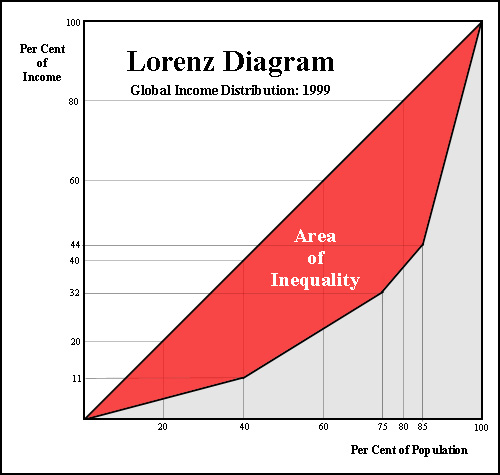
The upward sloping 45 degrees sloping line represents the equal distribution of wealth. An example will be the intersection point of the 20% of the income distributed and the 20% of the population. On the y-axis (vertical) you have the income distribution as expressed in decimals and on the x-axis you have the wealth of the nation. The area that is shaded in red represents the ‘area of inequality’ in income distribution. So the flatter the Lorenz curve the bigger will be the 'area of inequality' and hence income distribution.
An example of unequal distribution is where the 11% of income intersects with the 40% of the population on the Lorenz curve. This shows that 11% of the income is distributed to 40% of the population.
How Malaysia compared to the rest?
Anyway as of 2009 Malaysia is ranked 102 out of 136 countries surveyed by the CIA for the most unequal income distribution. The following is the income distribution of different ethnic in Malaysia and also its Gini coefficient from 1995 till 2009.
| Column1 | Column2 | Column3 |
| GINI Coefficient Of Malaysia | ||
| Etnicity |
2004
|
2009
|
| Bumiputra |
0.452
|
0.44
|
| Chinese |
0.446
|
0.425
|
| Indian |
0.425
|
0.424
|
| Others |
0.462
|
0.495
|
| MALAYSIA |
0.462
|
0.441
|
Source : Economic Planning Unit 2009
The performance of Malaysia’s Gini Coefficient from 1995 – 2009

Source : Department of Statistics Malaysia
According to World Bank, Malaysia was one of the few East Asian countries that reverse its income inequalities over the past decades but unfortunately reverses its direction since the 1990s. In other words policies drafted by policy makers since then are not effective.
This may be due to the bias policies that are drafted to the benefit of the ‘Bumiputra’ community while neglecting others and also the emergence of a new ‘ruling class’ that are make up of political cronies. This new group are given special treatments and are encouraged by the ‘powers to be’ to gobble up much of the nations strategic and big businesses in order to make up what they called the ’30 percent Bumiputra quota’.
Needless to say the end result is the re-emergence of the old Colonial type of ‘Rent Seeking’, businesses where being the monopoly or duopoly is the order of the day. As we know being in a position to monopolize any sector of the economy will only resulted in being contented. No incentive for being innovative and competitive made this conglomerates being redundant and badly managed and in the end left to decay.
Good examples include MAS, PERWAJA STEEL, PROTON and Bank Bumiputra just to name a few.
Monday, April 16, 2012
Investing in China Took Her From Rags to Riches to Death Row
 When a businessman makes a bad bet in America, he's apt to lose money. But as a couple of news items out of China this week reveal, doing business is quite a bit dicier in the Middle Kingdom. Make the wrong bet there, and you may lose more than just money. You may lose your life.
That's the fate awaiting two businesswomen sentenced to death by Chinese courts last week. The first, "rogue trader" Wang Caipang, is said to have defrauded investors of some $15.9 million borrowed for the purposes of buying equipment and property, and relending through "credit guarantee" firms. Instead, Caipang is said to have used the borrowed funds to speculate (badly) in the futures and gold markets, losing the bulk of the money.
If this story so far has you cheering "Hurray for China! Too bad Bernie Madoff was charged in America," then hold on a second. The allegations against the second defendant going to the gallows were a bit less clear-cut.
In fact, while greater in scale than the Wang Caipang case, the "fraud" alleged against 31-year-old Wu Ying hardly sounds criminal at all.
As reported on Bloomberg, Wu borrowed some $122 million from her investors, claiming that she would use the funds for the general business purposes of her "Bense" group of companies. Like Caipang, Wu wound up losing about half the money -- but there's a key difference here. Wu used the money for precisely the purposes she promised.
Thursday, February 9, 2012
Obama's weird deal: settlement before a full investigation into the fraud?
Will Government Bank Mortgage Deal Help or Hinder Prosecutions?
Uploaded by TheRealNews on Feb 9, 2012 - Yves Smith: How can Obama Admin. settle before they have fully investigated the fraud.
Enough to address the US housing bubble anger?
US to require banks to pay $25bn in fines over faulty home foreclosures
Uploaded by AlJazeeraEnglish on Feb 9, 2012
Uploaded by AlJazeeraEnglish on Feb 9, 2012
Sunday, November 20, 2011
Perspective from China:
Rising silver & gold demand in China :
Uploaded by PressTVGlobalNews on 19 Nov 2011 - On the Edge with Max Keeiser-11-18-2011.
Uploaded by PressTVGlobalNews on 19 Nov 2011 - On the Edge with Max Keeiser-11-18-2011.
Monday, October 31, 2011
What is the IMF?
Uploaded by AlJazeeraEnglish on Aug 18, 2011 - Report from Empire - the IMF on trial.
Producer Owen Fay
Producer Owen Fay
Friday, October 28, 2011
American Capitalist System ain't working!
Uploaded by enqilab on 29 Sep 2011 - Noam Chomsky talks on, his support on "occupy the wall street" protest to highlight the vicious social issues. An initiative to push for the relevant parties to fix the system.
Shouldn't there be an initiative to push for the relevant parties to fix the system.
Tuesday, October 25, 2011
The One Percent: Breaking Down US Wealth Distribution.
Uploaded by ForaTv on 20 Oct 2011 - Catherine Mulbrandon, illustrates the distribution of income in the U.S, comparing the earnings of the top one percent to those of the bottom 99.
Sunday, October 2, 2011
'Wall Street protests shows inequality'
Uploaded by PressTVGlobalNews on 2 Oct 2011 - Protests against poverty, unemployment and social inequality are spreading across several Metropolitan cities in the US, including New York, Chicago and Los Angeles.
Subscribe to:
Posts (Atom)


